Requesting a Test
Electronic or paper requests
All tests should be requested either electronically (for users with access to the Hamad Medical Corporation electronic requesting system) or manually using a paper requisition.
Paper requests should be legible. Non-HMC users should use the
DLMP Private Client Test Request Form for all pathology requests.
Note: For Non-HMC Private Clients
The Service User acknowledges and agrees that for certain laboratory tests to be accurately performed, it is mandatory for HMC to conduct additional tests, such as add-on, reflex, or confirmatory tests, as determined by HMC Laboratory. In such event, the Service User accepts to pay for these mandatory tests as required by HMC, even if such tests are not requested by the Service User.
The requesting physician should provide the patient, family, caregiver and/or next of kin with adequate explanation and instructions about the test, where appropriate. Where applicable, informed consent should be taken.
All requests should include the following information:
- Health Care (HC) number or Passport number or QID number*
- Patient’s full name
- Date of Birth
- Gender
- Nationality
- Patient location (hospital/clinic/entity, unit/department) with contact telephone number(s)
- Patient’s contact telephone number (where applicable)
- Test requested
- Test specification (routine or STAT), with clinical justification if STAT**. For electronic requests, the STAT option should be selected when placing the order. For paper requests, check the special STAT box if available on the request form OR hand-write ‘STAT’ on the form if a special STAT box is not available.
- Clinical information and indication for the test
- Type of specimen
- Source/anatomic site of specimen where applicable (e.g. microbiology, surgical pathology, cytopathology specimens)
- Collection date and time
- Name of the individual collecting the specimen with HMC corporation number or license number (if non-HMC employee)
- Requesting physician name (signature & stamp if available) with HMC corporation number or license number (if non-HMC physician). Note: all HMC requisitions should be placed by physicians only
- If test not requested by a physician (for non-HMC requisitions only), name, address and contact telephone number of the legally authorized person ordering the test or the laboratory referring the specimen
- Unique confidential specimen code if an alternative audit trail exists (for non-HMC requisitions only)
*Non-HMC facilities should provide a photocopy of the passport or QID along with the requisition.
**The STAT test option is not routinely offered to non-HMC facilities. Please discuss with the relevant specialty Head if this option is required on an individual patient basis. For HMC facilities: Any requests for additional or special STAT testing outside of the section-approved list must be discussed by the physician with the pathologist or designee and approval taken prior to proceeding with patient testing.
Some requests require additional special information as follows:
- Gynecologic specimens: Last menstrual period
- Coagulation tests: Anticoagulant medications being taken (e.g. warfarin, heparin)
- Surgical Pathology specimens: should be labeled and requisitions prepared in the room/operating theatre where the surgical procedure is performed. For frozen sections, the physician should inform the histopathology lab at least 24-hours ahead.
- Therapeutic drug monitoring e.g. antibiotic levels - drug therapy information, date and time of administration of the last dose (if applicable)
- Hormone levels - hormonal treatment if applicable
For any other special requirements for requesting, please check under the specific test in the
Lab Guide.
Verbal or telephone requests
These will only be accepted under exceptional circumstances limited to urgent situations in which immediate written or electronic requesting, in accordance with HMC Corporate policy, is not feasible to the physician, In such cases, the physician must countersign the order as soon as possible and not later than twenty-four hours after the request is made. Verbal or telephone requests are not normally accepted from non-HMC users.
Verbal or telephone requests for add on tests on specimens already in the laboratory will only be considered if the specimen has not been discarded and the request is made within a timeframe that is unlikely to affect the integrity of the sample and subsequent results. Please contact the relevant laboratory to discuss your requirements.
For specimen retention times, please see under the specific test in the
Lab Guide.
Note for non-HMC facilities: Not all tests in the Lab Guide are offered to non-HMC clients. Kindly check your service level agreement with our Department in the first instance. If you have any further queries, then please contact the DLMP Business Centre on
DLMP_Business_Center@hamad.qa
Patient Identification
All patients must be identified prior to:
- any procedure for the collection of specimens (e.g. blood extraction, point of care test)
- labelling of pathology specimens
- blood and/or blood products administration
All patients should be identified with at least 2 identifiers:
- Full name
- Healthcare (HC) number (if available) or Passport number or QID number
Additional identifiers are sometimes required as follows:
- Gender and Date and time of birth for neonates
Note: For infants/children in HMC facilities who do not have a Health Card, Child Health notebook (immunization card) or Dreama card (issued by the Orphan Care Center) shall be used for identification and cross reference.
Patient Preparation for Sampling
Appropriate specimen collection is essential to ensure clinically reliable test results, as pre-analytical variables can significantly influence analytical outcomes. Adequate patient preparation is therefore crucial to minimizing such variation.
Diet:
Most laboratory tests do not require dietary restrictions, allowing patients to eat and drink normally. However, a few tests necessitate avoiding specific food/supplements. For example, patients should be advised not to take biotin-containing dietary supplements for at least 12 hours prior to specimen collection due to potential assay interference with certain immunoassays. Instructions for dietary restrictions specific to tests are available in the Lab
Guide under the relevant test.
Fasting:
Some tests require fasting, meaning patients must abstain from eating, drinking, smoking, and using tobacco products for at least 10 hours prior to sampling (e.g., from 10 PM the previous night if blood is to be collected at 8 AM the next day). Drinking a small amount of water (approximately one glass) is permissible. Please see under the specific test in the Lab
Guide if fasting is required prior to sampling.
Medications:
Medications can influence laboratory results in various ways. For example, morphine can cause spasms of the sphincter of Oddi, affecting liver and pancreas test results. Intramuscular medications can irritate muscles, leading to the release of enzymes like Creatine Kinase, Alanine transaminase, and Lactate dehydrogenase into the blood, leading to erroneous results. It is advisable to wait 2-3 days after an intramuscular injection before sampling. Specific medications may need to be discontinued well before sampling, especially those affecting renin and chromogranin A levels. Instructions for medication restrictions specific to tests are available in the Lab
Guide under the relevant test.
Sampling Time:
Many analytes in body fluids demonstrate diurnal variation. Accordingly, repeat sampling should be performed at the same time of day on different occasions to ensure comparability. The timing of specimen collection is vital, as reference intervals are established for specific sampling times. For example, prolactin should be measured in the morning, at least three hours after awakening. Cortisol and testosterone are among analytes exhibiting significant diurnal variation.
Body Position:
Samples should ideally be taken with the patient in a sitting position to minimize the influence of body position on analysis results. Body position can affect the concentration of various substances in the blood due to fluid redistribution, with differences of up to 5% between samples taken while sitting versus lying down. Reference intervals are valid if the patient has been sitting for at least 15 minutes prior to sampling. Tests such as albumin and hemoglobin can be influenced by body position.
Physical Activity:
Engaging in physical activity shortly before sampling can impact certain components in body fluids. Even moderate activities, such as brisk walking or climbing stairs, can double the leukocyte count. Levels of Creatine Kinase and Aspartate transaminase are also affected by physical activity. Vigorous exercises, like cycling or running, should be avoided for at least two hours before sampling, especially for sensitive analyses. Ideally, patients should be seated for at least 15 minutes before sampling to ensure accurate results.
Specimen Labeling
General requirements for all specimens
Specimen containers should be labeled immediately after specimen collection and while in front of the patient (e.g. blood specimens).
STAT specimens should be sent in a STAT specimen bag (red color) if available. In case a red specimen bag is not available, please label the regular specimen bag as ‘STAT sample’. This will help identify STAT samples quickly and expedite testing.
Paper forms should NOT be placed with the specimen in the same compartment of the specimen bag to avoid any contamination of the form. They should be placed in the outside compartment separate from the specimen.
Specimens from Hamad Medical Corporation (HMC) facilities
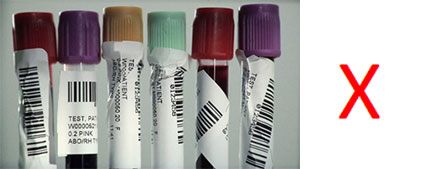
For Hamad Medical Corporation (HMC) requests placed electronically, please use the printed Cerner specimen labels. Labels should be affixed in a way that they do not obscure any part of the bar code on the specimen container.
Wrong!
Correct!
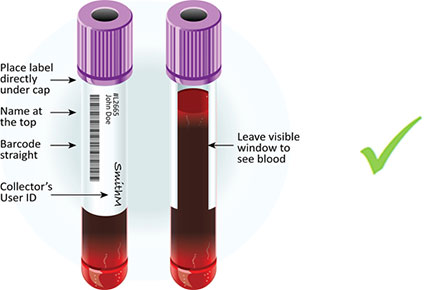
(Note: Collector’s User ID is applicable for paper requests only).
Specimens with paper request forms must have a label with the following information as a minimum:
- Patient’s full name
- Healthcare (HC) number (if available) OR QID number OR Passport number
- Date and time of specimen collection
- Collector’s name and corporation number
- Accession number (as applicable)
- Test name (as applicable)
- Specification of test (routine or STAT)
Specimens from non-HMC facilities
Specimens received from non-HMC facilities must have a label with the following information:
- Patient’s full name
- QID number or passport number
- Date of birth
- Healthcare (HC) number (Medical records number) if available
- Date and time of specimen collection
- Test name (as applicable)
Special labeling requirements
For any special requirements for labelling, please check under the specific test in the
Lab Guide.
Specimen Handling, Storage and Transport
General requirements for all specimens
All specimens must be handled, stored and transported at all times in accordance with universal and standard infection prevention and control precautions.
All specimens should be considered potentially infectious and should be transported in a closed container/box marked with a biohazard sign.
Specimen containers should first be placed in a plastic specimen bag with the biohazard sign (individual patient samples should be placed in separate biohazard transport bags) before putting in the transport container/box marked with the biohazard sign.
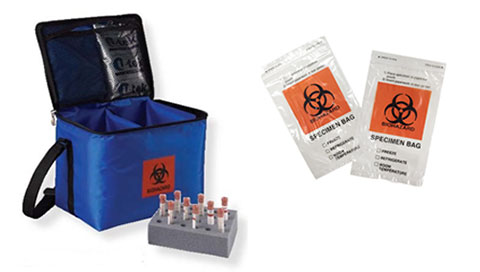
Appropriate personal protective equipment (PPE) should be worn when handling specimens in accordance with organization policy.
Specimens should be transported within the timeframe and at the required temperatures as specified for the test in the
Lab Guide in order to maintain specimen integrity. Note: for the purposes of this Lab Guide, room temperature is 20-25°C and chilled/refrigerator temperature is 2-8°C For samples that need to be frozen, please refer to the information under the specific test for the correct temperature required).
All specimens should be dropped off at the most appropriate specimen receiving
area.
STAT specimens must be transported immediately to the most appropriate specimen receiving area, except for
STAT samples for blood
bank which must be brought directly to the appropriate blood and not the specimen receiving area.
The majority of laboratory specimens are accepted 24/7 and processed as per the applicable test requirements of the relevant specialty. Please see under the relevant test in the Lab Guide for the days and times the test is performed. For laboratory opening times, please click
here.
Special requirements for handling, storage and transport
For specimens that are known or suspected to be highly infectious e.g. viral hemorrhagic fever, follow organizational infection prevention and control precautions and inform the laboratory in advance that specimens are being sent.
For any other special requirements for handling, storage and transport, please check under the specific test in the
Lab Guide.
Specimen Rejection Criteria
The Department of Laboratory Medicine and Pathology (DLMP) reserves the right to reject any test order that is improperly filled in or that is unclear (e.g., orders using non-standard or non-specific terms). In such cases, the test request shall be returned immediately to the requester for correction and/or clarification, with a request for a new laboratory requisition order.
The DLMP specimen rejection criteria, in line with applicable accreditation requirements, are as follows:
- Wrong specimen container
- Leaking or contaminated container
- Unlabeled or improperly labeled container
- Mislabeled specimen
- Improperly filled request form
- No specimen type documented
- No physician stamp or electronic order entry
- No clinical history/data documented
- Gross contamination of the specimen
- No request/electronic order received
- Test not available, even in external reference laboratory
- Delayed specimens that are judged unsuitable for analysis
- Send out test without payment (if applicable) and consultant stamp
- Specimen received with wrong date or time
- Clotted/hemolyzed specimens
- Wrong anticoagulant / collection tube
- Quantity not sufficient (QNS)
- Chylous specimen (for some tests)
- Absence of or inadequate fixation
- Other specific criteria depending on the receiving specialty. Please see under the specific test in the
Lab Guide for more information.
Note: Relabeling of a mislabeled specimen is not allowed unless the specimen is extremely difficult to recollect such as CSF, tissue, blood from infants and premature babies. In this case, the specimen collector will be called to the respective specimen receiving area to identify the specimen and relabel it. He/she shall write the cause of sending the mislabeled specimen, with date, time, signature and corporation number by completing the Form to Verify the Accuracy of Information of Irretrievable Specimens.
Unrepeatable/irretrievable specimens meeting the rejection criteria:
These will be processed in accordance with the policies and procedures of the receiving specialty. In all cases, the laboratory responsible will immediately contact the requestor/caregiver and may make a request for recollection if possible. If a decision is made to go ahead and process the specimen, a comment regarding sample suitability with respect to the rejection criteria will be added to the final report.
Communication with users when specimens are rejected:
For Hamad Medical Corporation (HMC) inpatients, the laboratory will, as soon as possible, inform the head nurse/charge nurse/staff nurse of the unit about the reason for the rejection, who shall in turn inform the requesting physician, and a new specimen shall be ordered and collected if needed.
For HMC outpatients, if the rejection is due to pre-analytical issues such as clotting, hemolysis, QNS (quantity not sufficient), overfilling, etc., the laboratory will contact the respective phlebotomist/ technologist who in turn shall inform the ordering physician about the rejection and make the arrangement for re-collection, if necessary. If the rejection is after results’ confirmation e.g. high hematocrit level, the laboratory technologist shall inform the physician to reorder the test and re-call the patient to Phlebotomy for recollection.
For non-HMC users, information regarding rejection will be communicated immediately to the respective laboratory contact person, with proper acknowledgement, and a request for a new sample shall be made, if possible and if needed.
Reporting of Results
Critical results and Critical (STAT) tests
The laboratory follows the Hamad Medical Corporation (HMC) Corporate policy regarding the reporting of critical results and critical tests (also called STAT tests). Each DLMP specialty has a defined list of critical results and STAT tests. Please note the STAT test option is not routinely offered to non-HMC facilities. Please discuss with the relevant specialty Head if this option is required on an individual patient basis.
Critical results are those that show a variance from normal range that represents a pathophysiologic state that is high-risk or life-threatening, is considered urgent or emergent in nature, and in which immediate medical action is likely necessary to preserve life or prevent a catastrophic occurrence. Critical results within the DLMP are defined and approved by the laboratory chairperson/designee in consultation with the clinicians served. All critical results, once available, are immediately released electronically or in a paper-based format and are also verbally relayed to the relevant end user within 30 minutes of the result being available or as per organizational policy and departmental SOPs.
STAT tests are those that require urgent or rush processing and communication of results (whether normal, abnormal or critical) as they may have an immediate impact on the management of a patient, and without which the care of the patient would be adversely affected. These tests are given priority over routine tests. For HMC laboratories that undertake STAT testing, all STAT tests are performed as a 24-hour service ,7 days a week. Results are reported immediately upon satisfactory completion of the test, with any critical results being reported in line with organizational policy and departmental SOPs.
Routine results
Routine results are normally released electronically to the HMC electronic health record (EHR). Certain reports e.g. genetic studies are issued only in paper format.
For non-HMC facilities, printed copies of the report will be issued for those facilities without access to the HMC-EHR (Electronic Health Record)
Referring a Specimen to an External Reference Laboratory
link from ext page
The Department of Laboratory Medicine and Pathology (DLMP) uses international reference laboratories for tests that are not in the scope of services for testing, in accordance with applicable accreditation requirements and contractual agreements.
Any tests requiring referral abroad must be discussed and agreed between the clinician and the relevant specialty Head and prior arrangement should be made with the DLMP referral laboratory. Kindly contact (+974) 40260349 or (+974)40264018 to speak to a referral laboratory staff member.
Patient specimens for referral should NOT be collected until the approval and arrangements are in place.
Due to reference laboratory working hours and holidays, please check with the referral laboratory before collecting samples to avoid compromising specimen stability.
Specimens shall be received and transferred to the referral lab by the DLMP central specimen receiving and processing area on the 3rd floor of the Qatar Rehabilitation Institute (QRI) building.
Test results, once received, will be uploaded to the patient file on Cerner (for patients from Hamad Medical Corporation facilities). Any significant results will also be telephoned to the requesting physician where appropriate.
Test Turnaround Times
The Department of Laboratory Medicine and Pathology regularly monitors the turnaround times of its STAT and routine tests to ensure results are released in a timely manner to support patient care.
Turnaround times are calculated from the time of receipt of the specimen within the laboratory to the time the result is released to the laboratory user.
For turnaround times of individual tests, please see in the
Lab guide under the Test Interpretation and Performance tab of the specific test.
Specimen Collection Manuals

|
Adult
|

